First of all, I just want to echo Fr. Martin’s and Lauren’s words of welcome to all of our new teachers and a welcome back to our returning teachers. It has definitely been a little quiet on campus these last couple of months without you and the students around. But that is going to be coming to an end rather quickly with school starting in just a few short days. It is good to have you all here!
Introduction
Catholic education has always been an important part of my life. As some of you know, I am the product of Catholic education. When I was growing up, I was a student at St. Charles Borromeo over in College Park. I was actually on that campus from the time I was 2 days old. My mom was always the homeroom mom for one of the Pringle kids. That continued until she started working at the school as a Teacher’s Assistant, a Specials Teacher, and then a Language Arts Teacher for Middle School.
And education is in my blood…not only is my mother a teacher, but so is my sister and my middle brother. My oldest brother has also been a teacher at one point. So, in other words, education holds a very special place in my heart in general…but more so as a priest. I understand it’s value and it’s importance, especially in forming disciples for the next generation. That’s kind of what this particular talk is going to be about this morning.
Mission of Catholic School Teacher
As Catholic school teachers, all of you are entrusted with that incredible mission of not only educating minds – teaching our young people how to read, write, solve math equations, discover new ideas and concepts in science – but you are also tasked with forming hearts in the faith. I know when my mom was teaching in the County System, that second mission is what she missed the most about Catholic education. She retired a few years ago now, but she would always tell me that was the most important part of her vocation as a Catholic school teacher – forming disciples, getting her students to come to a deep knowledge of Jesus, what He accomplished for us, and how He desired to be in relationship with us.
So today, I want to dive a little bit deeper into that, specifically by reflecting on Ephesians 4:1-6 and unpacking how the unity shown by the relationship of the Blessed Mother and the Apostles can help inspire us in that mission of sharing the Gospel with our students and then preparing them to go out into the world to be those evangelizers that are so desperately needed.
Ephesians 4:1-6
I, then, a prisoner for the Lord, urge you to live in a manner worthy of the call you have received, with all humility and gentleness, with patience, bearing with one another through love, striving to preserve the unity of the spirit through the bond of peace: one body and one Spirit, as you were also called to the one hope of your call; one Lord, one faith, one baptism; one God and Father of all, who is over all and through all and in all.
Unity in Belief and Mission
This particular section of St. Paul’s Letter to the Ephesians focuses on the need for unity in belief and in mission. It’s a reminder to us of the responsibility that we have received to live a life worthy of our Christian calling. The Lord has given us our faith through baptism, He has called us to be His sons and daughters. St. Paul is calling us to recognize what that means. He emphasizes that the virtues of humility, gentleness, patience, and love are essential for maintaining unity within the body of Christ. They’re essential to helping us to see who we are called to be and how we are called to live, specifically how we are called to love each other, how we are called to be Christ for others, to be His presence in the world.
That is something that is echoed throughout Scripture. In John 15:16-17, for example, Jesus tells His disciples and us: “It was not you who chose me, but I who chose you and appointed you to go and bear fruit that will remain, so that whatever you ask the Father in my name he may give you. This I command you: love one another.”
Sometimes, I think we need to stop every now and then and remember how blessed we are to have been chosen by Our Lord to be His disciples. We don’t always recognize that as a gift.
Pope Benedict XVI once said: “Each of us is the result of a thought of God. Each of us is willed. Each of us is loved. Each of us is necessary.” I come back to that quote so often because it reminds me that God has thought about me. He has thought about all of us that way. And He only desires to be in relationship with us, so He has put that desire on our hearts. He has given us the title of His sons and daughters through baptism.
Each of us is, in essence, another Christ. Sometimes we overlook that. Instead, we focus on how difficult it can be to live this Christian life and we lose sight of how the Lord is empowering us to live it through His grace, through participation in the life of the Church, through embracing these virtues of humility, gentleness, patience, and love.
Discipleship Isn’t Easy
The truth of the matter is: being a Christian isn’t easy. Jesus never promised us that it would be. In fact, He promised us the opposite. He even tells us that the world is going to hate us (cf Jn 15:18-19) for being His disciples. And as our culture continues to drift further and further away from God, further and further away from Christian values, further and further away from the Truth, we’re going to see that hate directed toward us in so many other ways. That’s what we have to prepare ourselves for and that’s what we have to prepare our students for. That’s why this idea of being unified in belief and mission is so important for us as Christians.
Example of the Blessed Mother and the Apostles
Thankfully, we have some examples that we can follow in doing that. When we look at the Blessed Mother and the Apostles in the early Church, they certainly understood what the world’s hate toward Christians looked like. They faced so many challenges because of their belief in Jesus as the Messiah. But they are examples for us in how to live out our faith in the proper sense.
Humility
When we look at the Blessed Mother, she is the example of humility for us, a virtue that we see in her life from the very beginning of the Gospels. At the Annunciation, we see her humble acceptance of God’s will when she says, “Behold I am the handmaid of the Lord; be it done unto me according to thy word” (Luke 1:38). That humility allowed her to be completely open to God’s plan. For us as those who lead others in the faith, for us as disciples of the Lord, we are called to embrace that same sense of humility, recognizing that the things the Lord has called us to are not for our own glory, but they’re part of God’s bigger plan. For you as teachers, recognizing that what the Lord has called you to is part of a bigger plan that He has for your students…He has called you to be their teachers for this time for a reason and we may not ever know what that reason is. But we have to remember that it is about Him…not us.
Unity in Prayer
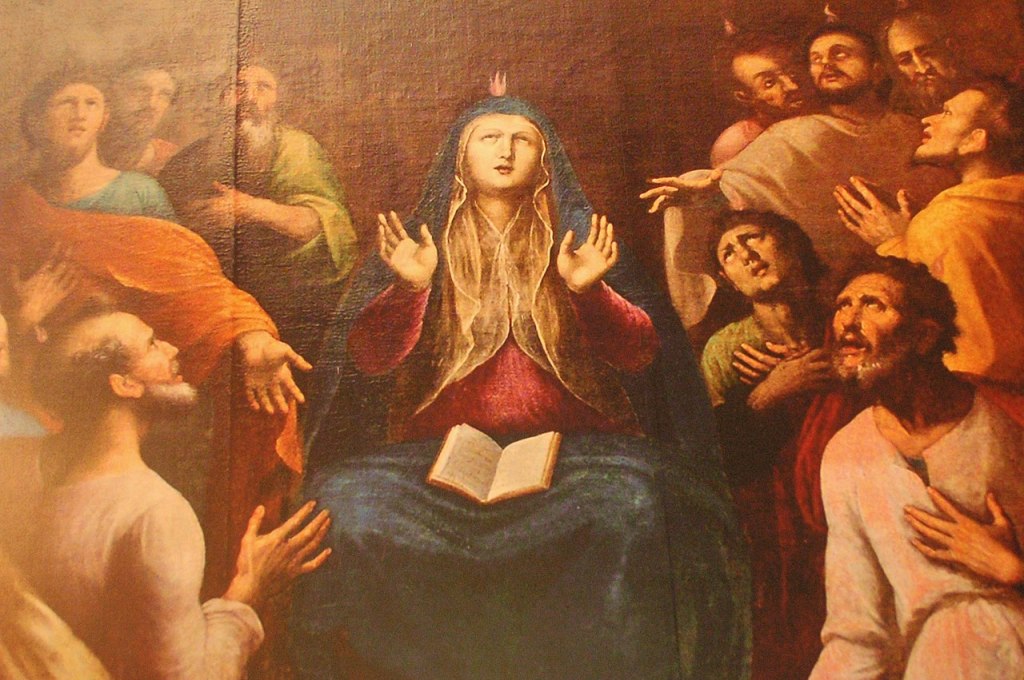
But that is also why prayer is important for us. After Jesus’ Ascension, Mary joined the Apostles in the Upper Room, praying together as they waited for the descent of the Holy Spirit (Acts 1:14). This unity in prayer is a powerful example for us. By fostering that deeper relationship with the Lord for ourselves and together as a community, we can come to recognize our need for the Holy Spirit, seeking His guidance in all that we do. When we do that as a school community, it leads us deeper into that unity; it leads us to be unified in our mission of evangelizing our students and leading by example.
Gentleness and Patience
Switching now to the Apostles…they are an example to us of how to embrace those virtues of gentleness and patience. It was demonstrated in their ministry. They faced incredible challenges and they all endured persecution. Remember, all of the Apostles died a martyr’s death. It wasn’t easy for them by any stretch of the imagination, yet they remained steadfast; they remained compassionate to those they served. They continued following the example of Jesus. Those virtues are essential in how we interact with students, with colleagues…and most importantly…with parents. No matter what we might be going through, we have to put those things aside to be Jesus for others, to be gentle and patient…because that will go a long way in the end.
Unity in Mission
Looking at the Apostles, they were also united in their mission to spread the Gospel. Despite their different backgrounds, their different personalities, they worked together. They were empowered to do that by the Holy Spirit. The same is said for us. All of us in this room come from different backgrounds. We all have different personalities. We have different quirks. We have a different way of teaching and walking with others. But despite those things, we are called to be unified in our mission of leading our young people to Jesus. So the Apostles should be a model for us as we collaborate together as colleagues to provide that faith-filled education for our students.
Sharing the Gospel with Students
I am a firm believer that being a teacher, being an educator is a vocation. It’s a beautiful vocation. When you see that student who has been struggling to understand something suddenly get it; when you see the spark of faith come alive in their eyes…that’s what teaching is all about. It makes it all worth it.
The people who had the most profound impact on my life were my teachers. In fact, I am still close to some of them today. I will say, my own vocation to the priesthood was really fostered by my teachers. They are responsible for who I am today. That is why your vocation is so important.
You will lead your students to an experience of Jesus…you will be Christ for them. That’s why it is important to seek to live out those virtues of humility, gentleness, patience, and love. That’s why we have to strive to be living examples of the Gospel for our students. Our actions often speak louder than our words.
So, an encouragement for this year for you: Foster a classroom atmosphere where prayer, scripture, and the sacraments are important. Help your students encounter Christ daily and understand the importance of their faith. Encourage them to share their faith with each other. Give them opportunities to engage in service projects, participate in faith-sharing groups, and practice articulating their beliefs. Help them to know Jesus. Share your faith with them. You have no idea what impact it will have on their lives and how they choose to be disciples of the Lord.
Conclusion
Know that Fr. Martin, Fr. Peter, myself, all of us are here to support you. We are incredibly grateful for what you do in the lives of our young people. You are helping to form disciples for the next generation, to form the leaders of our faith for those who will come after us. That is such a worthy vocation and we thank you for your yes.
Image: Altare dell’Eremo la Discesa dello Spirito Santo nel Cenacolo, Fabio Poggi. Licensed under the Creative Commons Attribution 3.0 Unported license. Wikimedia commons.
 Fr. Tom Pringle
